 33f9109999
The geometry path's merged ES/GS programs (VGT_SHADER_STAGES_EN.GS_EN) were compiled as mesh-stage programs whose input metadata was never filled in, so every such draw failed with "mesh shader translation configuration is not supported". Recompiler: - BuildShaderStageInputInfo takes the draw's MeshConfiguration; the mesh input helpers (primitive size, step and counts) are implemented. - The prologue emulates one NGG subgroup per workgroup: s2 GS_TG_INFO, s3 the merged wave info per wave, the GS vertex offsets (ES thread index times VGT_ESGS_RING_ITEMSIZE, odd strip triangles swapped), the primitive id, and the ES vertex and instance ids. An indexed draw's vertex id is read from the index buffer through a raw V# the driver puts in hidden user words 4..7. - s_sendmsg GS_ALLOC_REQ becomes MeshAllocate. The epilogue zeroes the allocation first, clamps it to the output limits, culls primitives no thread exported and decodes the 9-bit vertex indices. - The draw parameters live in the last six push dwords. A BDA fault in a mesh program no longer stops the invocation (as for other programs with barriers, the fault is recorded and the read returns zero), so every invocation reaches the subgroup barriers and the epilogue. - The cache keys cover the mesh configuration; requests serialize its new esgsItemSize field (version 4). Driver: - DecodeShaderStages reads VGT_ESGS_RING_ITEMSIZE (now in the draw key) and sizes the subgroup for its ES vertices, GS primitives and outputs. - Stages compile below the mesh draw parameters, which every mesh draw pushes; the mesh stage always takes part in the push range. - The index-buffer V# is set per draw (per record on the CPU-resolved indirect path); the index-buffer alias check spares read-only elements. - The workgroup and LocalSize checks count two guest lanes per invocation on 32-wide subgroups; mesh draws may carry a first vertex or instance. agc_driver_mesh_tests (EXCLUDE_FROM_ALL, needs VK_EXT_mesh_shader) recompiles a hand-assembled merged ES/GS program in the PS5 compiler's layout and draws indexed and non-indexed triangle lists in one- and two-wave subgroups and a triangle strip across odd-starting subgroups, reading the pixels back. agc_shader_replay prints a request's draw and mesh configuration. |
||
|---|---|---|
| .github | ||
| 3rdparty | ||
| core | ||
| docs | ||
| tools | ||
| .gitignore | ||
| .gitmodules | ||
| CMakeLists.txt | ||
| LICENSE | ||
| README.md | ||
README.md
About
Tool for automatic executables porting to Linux and Windows.
Includes a relinker that converts executable to the target system's native format and implementations of system prx libraries suitable for dynamic linking. No emulation or separate runtime process.
Status


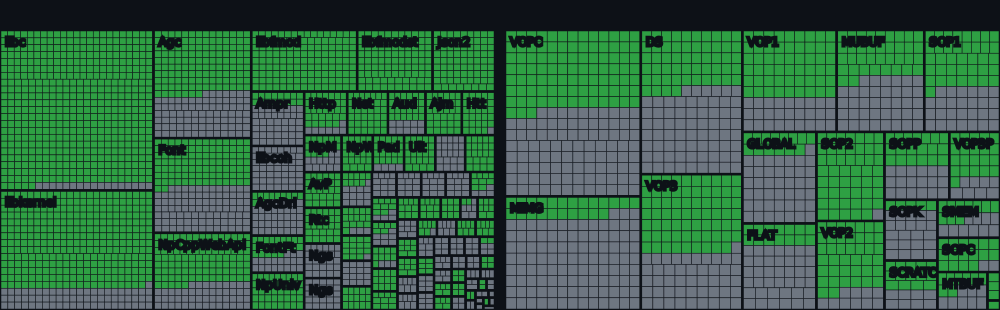
* System libraries: percentage of the functions known to the project so far (declared in core/libs/prx), not of every PS5 system function. The total grows as more functions are declared.
Dreaming Sarah (2D platformer) runs at a stable 60 fps on a GTX 1050 Ti / i5-7500 3.4GHz.
Unsupported or unexpected states strictly throw std::runtime_error. what() is printed to stderr and the process terminates.
The shader recompiler successfully produces SPIR-V (validated via Spirv-Tools when built with ANYPS5_ENABLE_SPIRV_TOOLS).
Technical debt of the project, code style conventions
Build
The relinker uses only the C++20 standard library and should build with any conforming compiler.
libc.prx implementations contain compiler-specific code. Linux builds work with GCC; on Windows, MinGW-w64 GCC 15.2.0 (winlibs-gcc15, x86_64-ucrt-posix-seh) is currently required.
The project targets maximum compiler portability. Support for additional compilers will be addressed after the first successful game launch.
Compatibility
See the game compatibility list for tested games and known issues.
Input mapping
SDL-mapped game controllers are supported, including analog sticks and triggers. Keyboard and mouse controls can be configured with an anyps5-input.ini file. See input mapping for the supported devices and configuration format.
Disclaimer
This project is intended for interoperability, research, preservation, and compatibility purposes. It does not include, distribute, or require copyrighted software, firmware, cryptographic keys, or proprietary libraries. Users are responsible for ensuring that any binaries used with this project are obtained and used in accordance with applicable laws and their respective license terms.
License
This project is licensed under the GNU General Public License version 2 only.