 4e7511dc32
#2839 decides f32 product tininess after rounding, in all four f32 round modes, from the exponents and a UMulHi and IMul of the significands, and builds the flushed value from them. To nearest even, the mode of shaders without a known float mode and of the 0xc0 most titles use, one multiply decides it: one factor times 2^64, which is exact below 2^64, times the other factor rounds the exact product once to 24 bits in the normal range, and 0 < |that| < 2^-62 is tininess after rounding. A product that rounds up to 2^-126 is then not tiny and keeps the emitted product, which is 2^-126 there, so nothing has to be built from the significands. The flush of v_mul_f32 v5, v6, v7 takes 12 IR instructions instead of 34, counted as the instructions the flush select needs beyond the product. vector_constant_factor_tininess pins 12 to nearest and 36 for the directed path of the same instruction, and checks that the directed modes and v_mad_legacy_f32 (before rounding) keep #2839's check. Its round-to-nearest branches are removed as unreachable. The f32 denormals entry says which rounding the check inherits: the multiply is a plain OpFMul like the product, with no f32 rounding mode requested, so it relies on the driver rounding f32 to nearest even, as the products do. F32ConstantFactorTininess names the row a check before rounding flushes, 0x3f7ffffe * 0x00800001, which keeps the emitted 0x00800000. Against #2839 to nearest even, a model of both checks agrees on 1,074,977,546 operand pairs (every 24-bit significand at both rounding thresholds, random pairs, specials) with each other and with an exact reference. On an RTX 5070 the outputs of #2839's own tininess and mixed-source shaders are bit-identical with either lowering over 165,298 and 164,008 generated rows in all six float modes tested. Co-Authored-By: Claude Opus 5.5 <noreply@anthropic.com> |
||
|---|---|---|
| .github | ||
| 3rdparty | ||
| core | ||
| docs | ||
| tools | ||
| .gitignore | ||
| .gitmodules | ||
| CMakeLists.txt | ||
| CONTRIBUTING.md | ||
| LICENSE | ||
| README.md | ||
README.md
About
Tool for automatic executables porting to Linux and Windows.
Includes a relinker that converts executable to the target system's native format and implementations of system prx libraries suitable for dynamic linking. No emulation or separate runtime process.
Usage, Build instructions, Architecture, Technical debt of the project, code style conventions, contributing
Status


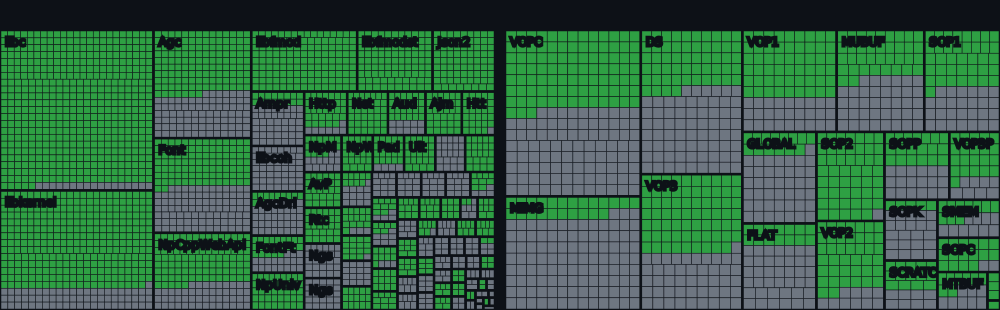
* System libraries: percentage of the functions known to the project so far (declared in core/libs/prx), not of every PS5 system function. The total grows as more functions are declared.
Dreaming Sarah (2D platformer) runs at a stable 60 fps on a GTX 1050 Ti / i5-7500 3.4GHz.
Unsupported or unexpected states strictly throw std::runtime_error. what() is printed to stderr and the process terminates.
The shader recompiler successfully produces SPIR-V (validated via Spirv-Tools when built with ANYPS5_ENABLE_SPIRV_TOOLS).
Compatibility
See the game compatibility list for tested games and known issues.
Input mapping
SDL-mapped game controllers are supported, including analog sticks and triggers. Keyboard and mouse controls can be configured with an anyps5-input.ini file. See input mapping for the supported devices and configuration format.
Disclaimer
This project is intended for interoperability, research, preservation, and compatibility purposes. It does not include, distribute, or require copyrighted software, firmware, cryptographic keys, or proprietary libraries. Users are responsible for ensuring that any binaries used with this project are obtained and used in accordance with applicable laws and their respective license terms.
License
This project is licensed under the GNU General Public License version 2 only.