 a431082abc
PPSA21564's galaxy map renders a 1920x1080 surface as a color target whose CB names DCC keys at one address and then writes it from a compute shader whose T# names keys at another. Both key ranges read uncompressed every frame, but the storage cache remade the surface's image whenever a descriptor named metadata other than the image's, so the image was flushed, destroyed, created and uploaded twice a frame (1231 constructions in a 56 s scene), with the views and draw recipes built on it thrown away each time. A descriptor naming other keys now keeps the image when the move is unobservable: the image's own keys and the named keys both read uncompressed, and its content was neither uploaded nor filled under a clear code. That is exactly the content an image made under the named keys would hold once this one's pending results were stored. Any other case (a fast clear of either key range, a register clear, an image holding a clear) still remakes the image as before, so clears of the new keys reach it and pending results are stored first. Every proof that stands in for a lookup checks the same rule: the sampled view hit, the fast revalidation of views and storage elements (storage elements now record their descriptor's keys), the own-object refresh, and the draw recipe's resident targets. Named-key scans keep per-image proofs, so a repeated check costs no scan while the key bytes are unstamped. agc_dcc_key_sharing drives KeysServeSurface, the rule ServesKeysAt uses, through a model of the storage cache. |
||
|---|---|---|
| .github | ||
| 3rdparty | ||
| core | ||
| docs | ||
| tools | ||
| .gitignore | ||
| .gitmodules | ||
| CMakeLists.txt | ||
| CONTRIBUTING.md | ||
| LICENSE | ||
| README.md | ||
README.md
About
Tool for automatic executables porting to Linux and Windows.
Includes a relinker that converts executable to the target system's native format and implementations of system prx libraries suitable for dynamic linking. No emulation or separate runtime process.
Usage, Build instructions, Technical debt of the project, code style conventions, contributing
Status


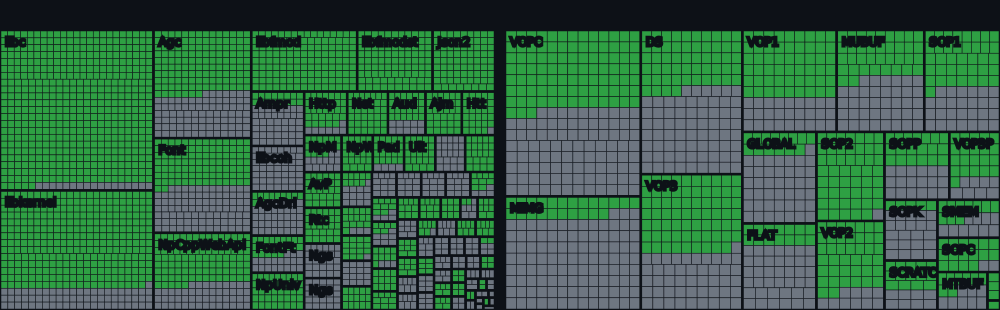
* System libraries: percentage of the functions known to the project so far (declared in core/libs/prx), not of every PS5 system function. The total grows as more functions are declared.
Dreaming Sarah (2D platformer) runs at a stable 60 fps on a GTX 1050 Ti / i5-7500 3.4GHz.
Unsupported or unexpected states strictly throw std::runtime_error. what() is printed to stderr and the process terminates.
The shader recompiler successfully produces SPIR-V (validated via Spirv-Tools when built with ANYPS5_ENABLE_SPIRV_TOOLS).
Compatibility
See the game compatibility list for tested games and known issues.
Input mapping
SDL-mapped game controllers are supported, including analog sticks and triggers. Keyboard and mouse controls can be configured with an anyps5-input.ini file. See input mapping for the supported devices and configuration format.
Disclaimer
This project is intended for interoperability, research, preservation, and compatibility purposes. It does not include, distribute, or require copyrighted software, firmware, cryptographic keys, or proprietary libraries. Users are responsible for ensuring that any binaries used with this project are obtained and used in accordance with applicable laws and their respective license terms.
License
This project is licensed under the GNU General Public License version 2 only.