 b8d71fc7f2
connect() on a guest datagram socket checked the address family before
doing anything, so an AF_UNSPEC (null) address failed with EAFNOSUPPORT
and left the socket connected: getpeername() still reported the old
peer, send() without an address still went there, and datagrams from
any other sender were dropped by the host.

FreeBSD 11.4 disconnects a connected datagram socket first and only then
rejects the address. sys/kern/uipc_socket.c, soconnectat():

	 * If protocol is connection-based, can only connect once.
	 * Otherwise, if connected, try to disconnect first.  This allows
	 * user to disconnect by connecting to, e.g., a null address.
	 */
	if (so->so_state & (SS_ISCONNECTED|SS_ISCONNECTING) &&
	    ((so->so_proto->pr_flags & PR_CONNREQUIRED) ||
	    (error = sodisconnect(so)))) {

udp_disconnect() (sys/netinet/udp_usrreq.c) clears the peer and resets
only the local address, keeping the local port:

	in_pcbdisconnect(inp);
	inp->inp_laddr.s_addr = INADDR_ANY;

after which in_pcbconnect_setup() (sys/netinet/in_pcb.c) returns
EAFNOSUPPORT for the full-size address, as main already does. connect(2)
documents it: "Datagram sockets may dissolve the association by
connecting to an invalid address, such as a null address."

A connected internet datagram socket given an address whose family byte
is 0 is now disconnected on the host first (AF_UNSPEC on Linux, a zeroed
address on Windows) and the call then fails as before. Linux also drops
an ephemeral local port on that disconnect, so the port is bound again
on the wildcard address, which is what FreeBSD leaves. A host
failure during the disconnect is returned as the call's error. Stream
sockets keep the previous path.

Co-Authored-By: Claude Opus 5.5 <noreply@anthropic.com>
|
||
|---|---|---|
| .github | ||
| 3rdparty | ||
| cmake | ||
| core | ||
| docs | ||
| tools | ||
| .gitignore | ||
| .gitmodules | ||
| CMakeLists.txt | ||
| CONTRIBUTING.md | ||
| LICENSE | ||
| README.md | ||
README.md
About
Tool for automatic executables porting to Linux and Windows.
Includes a relinker that converts executable to the target system's native format and implementations of system prx libraries suitable for dynamic linking. No emulation or separate runtime process.
Usage, Build instructions, Architecture, Technical debt of the project, code style conventions, contributing
Status


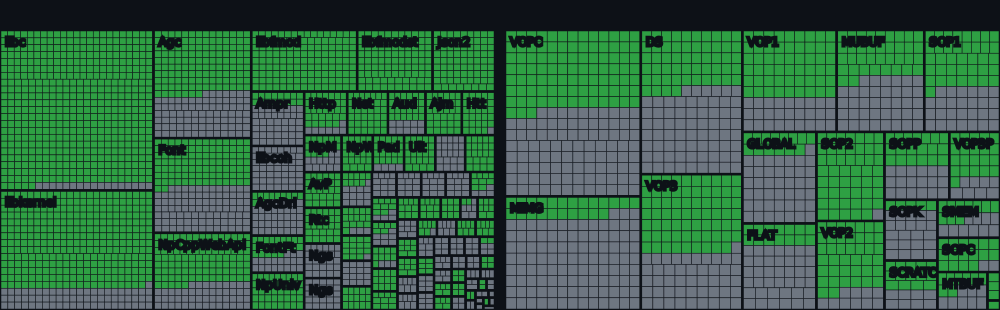
* System libraries: percentage of the functions known to the project so far (declared in core/libs/prx), not of every PS5 system function. The total grows as more functions are declared.
Unsupported or unexpected states strictly throw std::runtime_error. what() is printed to stderr and the process terminates.
The shader recompiler successfully produces SPIR-V (validated via Spirv-Tools when built with ANYPS5_ENABLE_SPIRV_TOOLS).
Compatibility
Per-game progress (stage reached, open blockers, libraries and GPU coverage) is tracked on the blocker map, a community project built from public GitHub data (source). Test reports go in the Game bring-up discussions, one thread per title.
Input mapping
SDL-mapped game controllers are supported, including analog sticks and triggers. Keyboard and mouse controls can be configured with an anyps5-input.ini file. See input mapping for the supported devices and configuration format.
Disclaimer
This project is intended for interoperability, research, preservation, and compatibility purposes. It does not include, distribute, or require copyrighted software, firmware, cryptographic keys, or proprietary libraries. Users are responsible for ensuring that any binaries used with this project are obtained and used in accordance with applicable laws and their respective license terms.
License
This project is licensed under the GNU General Public License version 2 only.